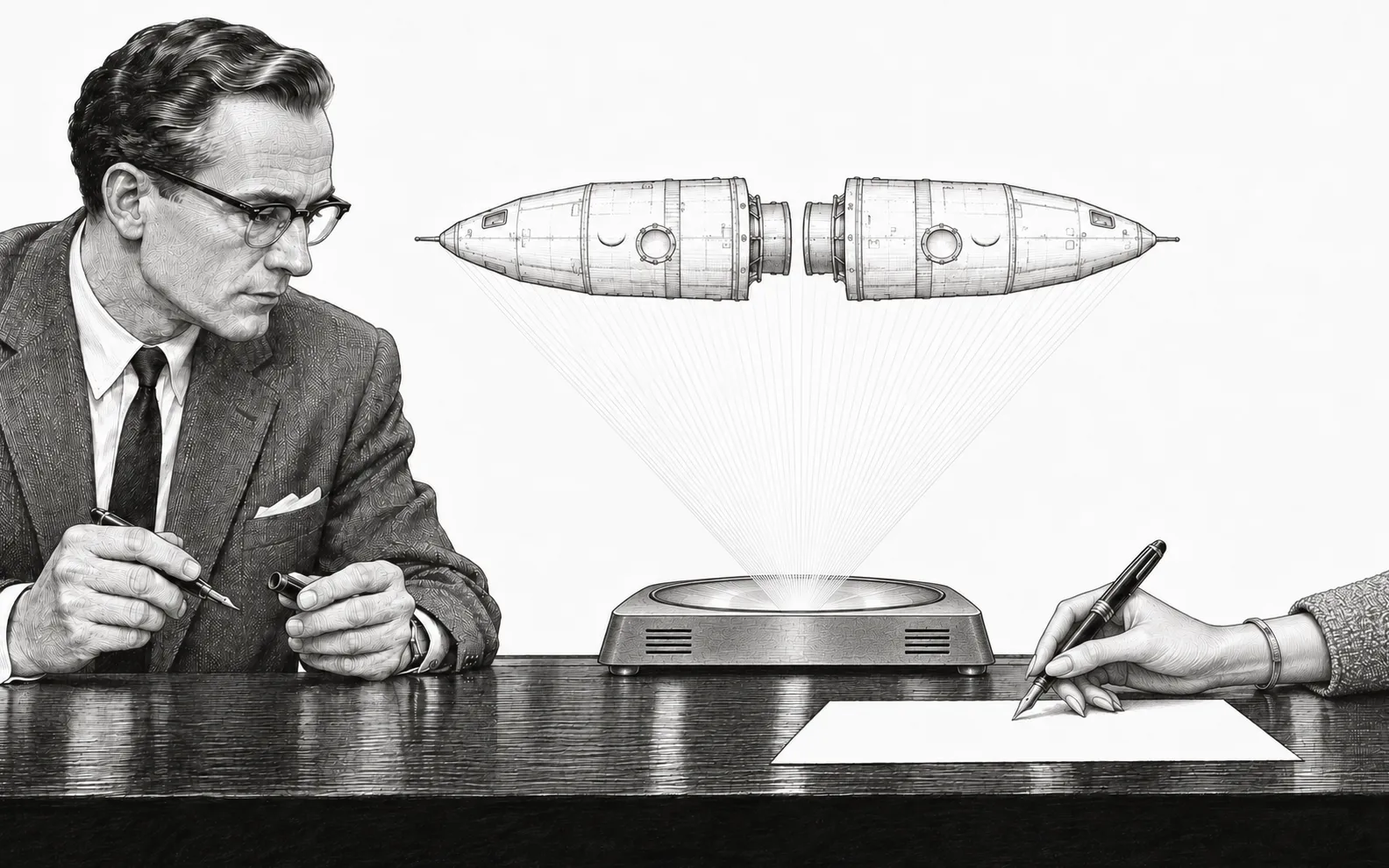
The briefing room smelled faintly of coffee and disinfectant. Someone had set a cup at each place with the handle turned to the right.
Dr. Ludwig Schmidt arrived early. In the corridor outside the secure wing, a framed poster offered the latest wording on discretion. He remembered the little brass keyhole at the bottom of the frame better than he remembered any of the things the poster had said.
The projector was already warm. Above the pedestal hung a title in bureaucratic blue. PROJECT BACKSLASH. The name had been chosen by people who believed in nouns that sounded like decisions.
Schmidt laid his folder on the table and took out a pen, though he had nothing to write. Across the room, two cameras sat in their mounts like patient insects. It occurred to him to wonder whether the cameras, too, had counterparts somewhere. He took the cap off his pen and put it on again.
The door opened with a soft pneumatic sigh. Four officials came in, keeping the easy step of people who had spent years being photographed together. Undersecretary Reed led them. He was tall, tanned, and wore a small flag on his lapel. Behind him came a woman carrying no folder. The two younger men each had a thick one.
Reed shook hands with Schmidt. His grip was firm without being personal.
“Doctor Schmidt. Thank you for making yourself available.”
“Of course.”
The woman met his eyes for a moment, then took the chair opposite his and laid her hands flat on the table.
“Director Weiss,” Reed said. “Communications and Public Affairs.”
“Clara Weiss,” she said.
Schmidt knew the name from the bottom of internal emails. It has been agreed. The wording has been cleared. He had often wondered who else had been in the room when things were agreed. Now, apparently, he was going to find out.
“The President has been briefed in outline,” Reed said. “We’re told you have the final piece.”
Schmidt adjusted his spectacles. “The drive can take a vessel to light speed. There’s a condition.”
Weiss looked up at the title above the pedestal. “What condition?”
Schmidt pressed a button. The title gave way to two silver vessels, pointing in opposite directions, their sterns a hand’s breadth apart. Even the small dent beside the docking hatch appeared on both hulls. He had kept it in the model over the technician’s objection.
“The drive only works in pairs,” he said.
“We have to build a second ship?” Reed asked.
“We build one. When we engage the drive, it generates a counterpart. Same mass, same structure. The two vessels leave in opposite directions.”
One of the younger officials leaned forward. “You mean conservation of momentum.”
“That’s one condition. Equal entries on opposite sides of a ledger. But a block of lead of the right mass won’t do. The drive reproduces the ship, down to the last particle. Where the first ship has an electron, the other has a positron.”
“Antimatter,” the official said.
“Yes.” Schmidt was glad to have a word on the table that everyone recognized. He had been dreading the next one.
“And the crew?” Weiss asked.
“The crew goes with it. If the captain has a hand on the switch, so does the captain of the other ship.”
For a moment all he could hear was the ventilation.
“So we have a copy,” said the younger official.
“Standing here, you can call one a copy. Put yourself on board. You remember the physical. You remember signing for your kit. You have a thumb that aches where you caught it in the hatch this morning. Which captain have I just described?”
Reed ran a finger around the rim of his cup. “Can they speak to each other?”
“Once the drive engages, a signal from either ship can never catch the other. Every second the signal travels, the ship it’s meant for has gone another light-second.”
“And if the vessels come into contact?” Weiss asked.
“Matter and antimatter annihilate on contact. Neither crew would survive a collision.”
“How likely is that?”
“They separate at ignition. On those trajectories they’ll never meet again.”
Weiss had produced a pen. “Is ‘never’ a word you’d want in the statement?”
Schmidt looked at the straight lines extending from the two little ships. “Put ‘on those trajectories’ in front of it and I’ll sign it.”
She wrote something down. Upside down, her handwriting was too small for him to read.
Reed leaned back. “So we lose one.”
Schmidt glanced at the projection. The dent in the first hull had rotated out of sight. “Which one?”
“We chose a destination, Doctor. One ship is going there. I’m asking about the one going the other way.”
“From their point of view,” said the younger official, “what happens?”
“From their point of view, they are the mission.”
Weiss’s pen stopped. “Say that again.”
Schmidt could already see his sentence standing alone on a page. “Both captains remember being given command.”
Reed folded his hands. “Congress gave us the money to advance national capability. If we’re also in the business of manufacturing metaphysical dilemmas, I’d like to hear about it before the next appropriations hearing.”
“We might keep ‘manufacturing metaphysical dilemmas’ out of the statement,” Weiss said.
The corner of Reed’s mouth tightened. “I believe we can agree on that.”
“The device works,” Schmidt said. It came out with more force than he had intended. Once, he would have given a great deal to be the man who could walk into this room and say those three words.
“I’m sure it does,” Reed said. “Yet here you sit like a man who’s discovered something he’d like to undiscover.”
Schmidt let out a breath that was almost a laugh. “It depends on what we think it’s for.”
The younger official opened his folder to a fresh page. “Let’s be practical. We launch a ship. We get a ship.”
“We get two,” Schmidt said.
“We get one ship under orders to go where we send it,” Reed said. “The other is a consequence of how the drive works. I don’t see on what grounds you can say it’s ours.”
“Ours in origin,” Weiss said, still writing. “Jurisdiction is another question.”
“Exactly,” Reed said.
“With respect, Undersecretary, both crews took the oath.”
Reed considered him. “I’m due at the White House at four. Suppose I tell the President there’s a second crew and we mean to send them in the opposite direction. What do I tell him when he asks who’s going to break it to the families?”
“The families will ask about the oath too,” Weiss said. “So will their lawyers. After that come the international committees.”
“Committees?” the younger official asked.
“They will appear,” Weiss said. “Like mold.”
Reed turned back to the projection. “Can we arrange for the second vessel to be empty?”
“We can launch an empty ship,” Schmidt said. “That gives us two empty ships.”
“I mean with our crew aboard.”
“Then the other captain goes too.”
The younger official closed his folder. For the first time since they had come in, nobody seemed inclined to help Schmidt put it into other words.
At last Weiss said, “Doctor, what’s the least dishonest description you could give me?”
It surprised him how grateful he was for the word dishonest. He could work to that tolerance.
“Engaging the drive sends two crews out. We’ve picked a destination for one. So far as I know, nobody here has even looked at what lies ahead of the other.”
Weiss waited, and he understood she was giving him time to take back the last sentence. He left it with her.
“All right,” Reed said. “We proceed with the statement.”
Schmidt looked at him. “You have it already?”
“I have an appointment at four,” Reed said again, quite gently. “We will announce that humanity has achieved light-speed travel. We will speak of a breakthrough, of a bright frontier. The President can have the internal details separately.”
“Internal details,” Weiss murmured. This time she left the cap on her pen.
Reed stood and offered Schmidt his hand. “Excellent work, Doctor. The President will be pleased.”
Schmidt took it. Across the table his coffee sat untouched, the handle still pointing to the right.
Weiss lingered at the door while the others filed into the corridor. Above the pedestal the two little ships were receding. Presently the model would reset and they would have to do it all over again.
“What will you tell him at four?” Schmidt asked.
“Reed has the four o’clock appointment. I get the families.”
He looked at her then.
“I’d like you there,” she said. “They ought to be able to ask somebody about that other ship.”
He could have said yes. By the time he thought to do it, the door had closed.
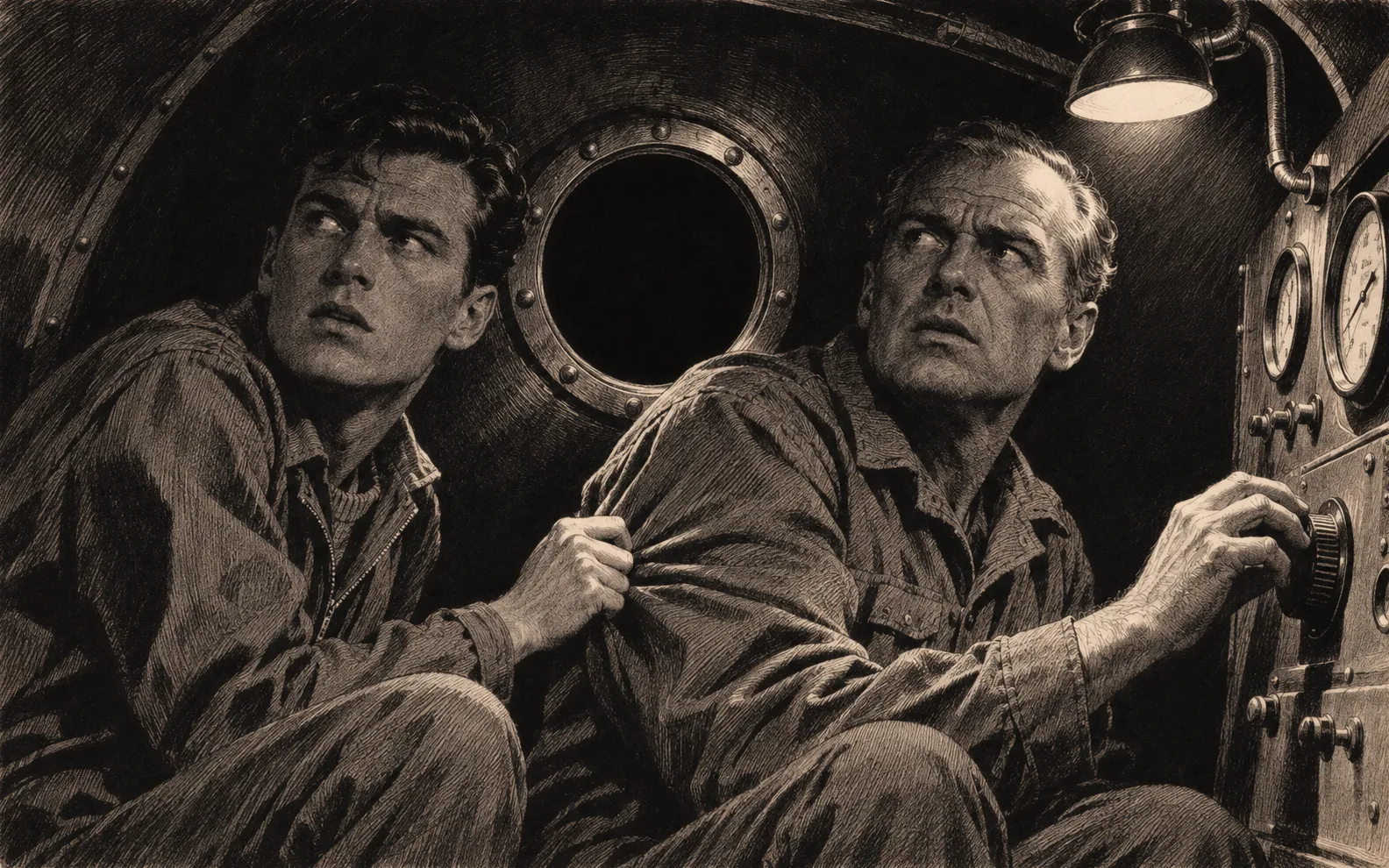
Schmidt remained by the pedestal. He tried to imagine the moment after ignition from inside one of the ships. A sore thumb resting on a switch. A face turned toward the next seat. Somewhere out there a man with the same sore thumb would turn to the same face, and each could spend the rest of his life wondering what the other man had said.
His imagination supplied another briefing room, down to the brass keyhole in the corridor and the cold coffee in the cups. He knew perfectly well what the drive could duplicate. Still, he found it easier to picture a second room than to give the man in it a different answer for Weiss.
He switched off the projector. Both ships vanished at once. For a few seconds he could see his reflection in the dark glass of the pedestal, his hand still on the switch.
He looked at the closed door. “I wonder which one of us just left the room.”

No comments yet