The infirmary never really slept. Even when the corridor fell quiet between rounds, the lights kept their pale glare and the ventilation kept up its measured breath. Somewhere in the building, a relay clicked with the patience of a metronome.
Major Adrian Sloane sat behind a steel desk, his cuffs resting against an edge worn smooth by years of sleeves and paperwork. The white coat looked borrowed. Across from him, Felix Harrow, a war correspondent who knew his way past the night watch, balanced a notebook on his knee and tried to get his pen to catch.
“So,” Felix said. “It happened again.”
“Yes. And this stays between us.”
“Between us.” Felix gave the pen another click. Sloane waited for a promise. Felix had known him long enough to recognize the pause. “Last time it was the bathyscaphe. Two men in a steel sphere with a mile of water overhead. How do you get a message down there?”
“It didn’t arrive,” Sloane said. “It started.”
“Started where?”
“In the men, as far as I can tell.”
“You mean they were transmitting?”
“I mean they heard a tone. High, intermittent. It kept coming back. After a while they began to think somebody wanted their attention.”
“When somebody knocks twice on your door, you do generally open it.”
“I do,” Sloane said. “What would you do if you opened it and the knocking followed you down the hall?”
“Take it to a doctor, I suppose. You’ve always had that advantage, Adrian. Call a thing a symptom and you can make it small.”
“Small things have killed more men than large ones.”
Felix tapped the pen against his notebook. “All right. I’ll give you two men under pressure hearing their own blood. What about the pilots? The radar technicians? And now the visitors?”
Sloane glanced at the slim folder on the corner of his blotter. “That’s what you’ve been waiting to ask.”
“Can you blame me? People who’ve never been in the same room keep describing the same thing.”
“The same thing?”
Felix knew the phrases by heart. “One said it was like someone knocking on the inside of his skull. One said it was like hearing a whistle down a corridor and never finding the right door. Then there was the man who said it sounded like a voice he could almost understand if he held his breath.”
“What did he hear when he held it?”
“He didn’t say.”
Sloane pushed the folder across the blotter. “Read.”
There were audiograms annotated in a small, precise hand. Dates, duty stations, pressure readings. On one sheet the men had been asked to match what they heard to a tone played through headphones. Felix ran a finger down the results. 4 kHz, 6 kHz, 7.5 kHz. A pencilled note in the margin read Subject reports ‘whispering’ at onset.
“How long have you been collecting these?”
“Months. Some of the reports go back further. Nobody thought to put them together.”
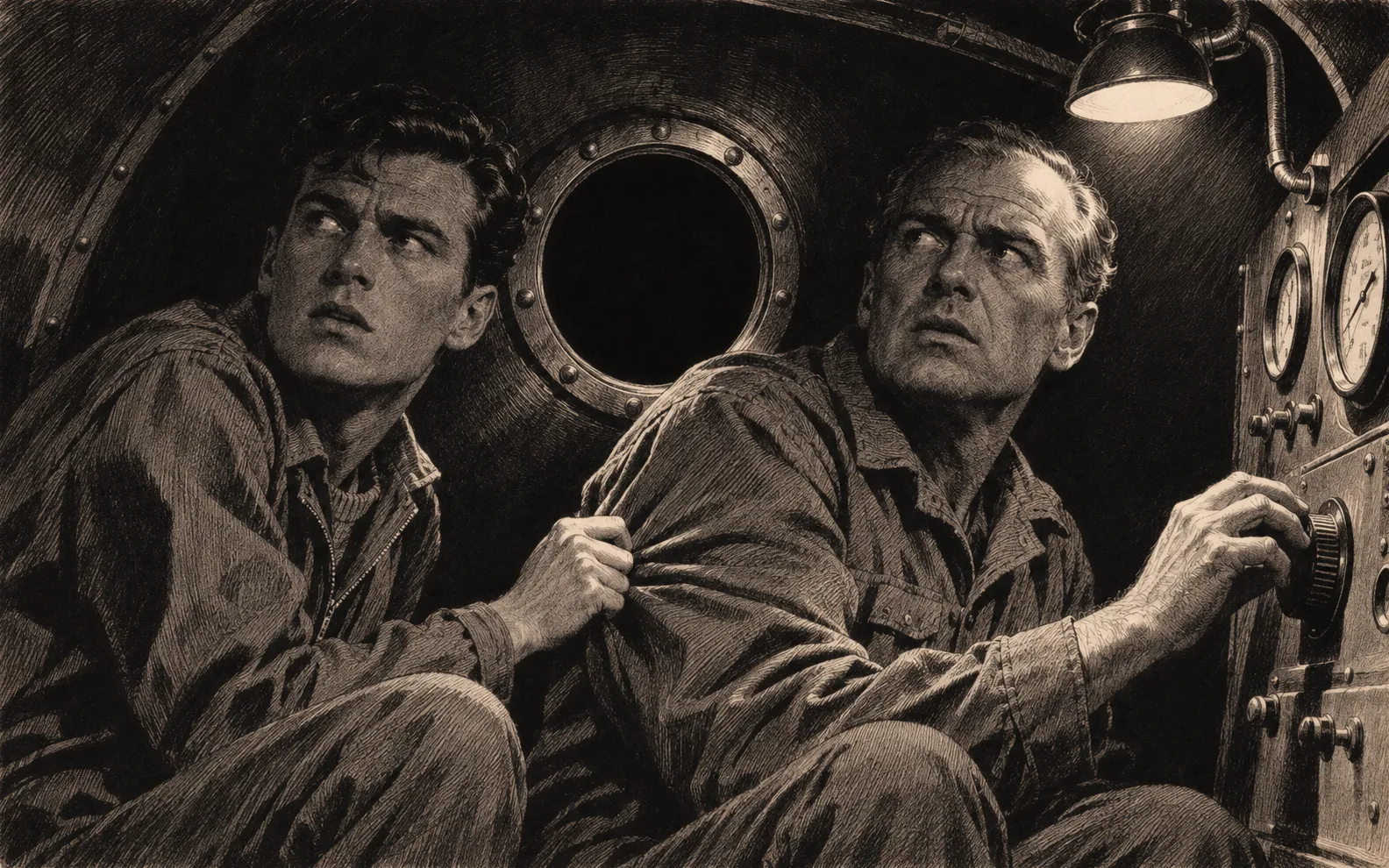
A photograph clipped to the trial report showed the two men in their harnesses, knees almost touching, the instrument panel lit like a small city at night. At the edge of the picture, just clear of the instruments, one man had hold of the other’s sleeve.
Felix turned the page. “You think their own ears did this?”
“That would account for what they heard. As for what brought it on, look at the duty records. There’s vibration, machinery running for hours on end. Half these men went on shift short of sleep. I could make you a case for any of those.”
Beside one technician’s badge number someone had written First noticed it near the high-power oscillators.
“And the visitors?” Felix asked.
“We examined them after the incident. The interpreters had a few pictures to work with. Mostly we used our hands. One of the visitors kept pointing over my shoulder. When I turned to look, it pressed its palm against the side of its head. The other touched its throat, the way you’d feel for a pulse.”
“Could you tell what they made of it?”
“They looked irritated.”
Felix had imagined a good many things about that encounter. Irritation had never figured in any of them. “How many times did you turn round?”
“Twice,” said Sloane. “The second time I think it was irritated with me.”
For a moment Felix could see his friend in the examination room, turning obediently to look at a bare wall. He glanced back at the columns of figures. “So a man sits at the bottom of the sea thinking he’s been singled out by the cosmos, and you’re telling me it’s a wiring fault.”
“I imagine we’d miss quite a lot if our ears were any less sensitive.”
“Still. Why those two men on that particular dive? They’d been down before.”
Sloane opened the folder at the back and laid two sheets side by side. One was the bathyscaphe’s trial log, the other a power record from the radar station on the headland. Someone had underlined the times the men reported the tone. Three entries on the radar sheet carried matching pencil marks. Each time, within the same minute, the array had come up to full power.
Felix ran his finger across the gap between the sheets. “Has that happened on any other dive?”
“It’s the only trial I have both records for.”
“Who else has seen this?”
“Command has asked for the files.”
“And you’re afraid they’ll put the men back in the sphere.”
“I’m afraid somebody will ask those men to listen for it again. Imagine going down a second time with orders to make out what the voice is saying.”
“They might want to know, too.”
“They came to me because they couldn’t sleep, Felix. I’d like them to feel they can come back.”
“So you give it a name and it becomes small enough to be ignored.”
“Small enough to be treated,” Sloane said.
Outside, a cart wheel squeaked on its way down the corridor. When it passed, Felix could hear the hum of the lights above the desk.
“Tinnitus,” he said.
Sloane nodded.
“I’ve heard men call that harmless.”
“It looks harmless enough across a desk. Ask one of those men at three in the morning. The whole house is quiet by then. He can remember what that used to sound like.”
Felix turned back to the examination notes. “Would you call it that in the visitors, too?”
“I’d keep the question mark. I know what a man means when he puts a hand to his ear. Even then it helps if he can tell me.”
Felix tried to imagine crossing that impossible distance and finding, on arrival, that you had a noise in your head and the only person who might help kept turning round to look for it. Irritation, at least, had come through.
He slid the folder back across the desk and slipped the pen into his breast pocket. “You know, I came here hoping somebody had said something.”
“What did you hope they’d say?”
Felix had got as far as the headline. Beyond that he found he had nothing.
Felix stood up. From here the pencil marks on the two logs looked like lines drawn straight across the gap.
“Do you ever wonder about those times, Adrian?”
“Of course I wonder. Why do you think I kept the sheets?”
Felix paused with his hand on the door. “In the field, men used to swear they could hear artillery in their teeth long after the guns stopped. Bones remembering, one of them called it.” He worked his jaw a little. “I always liked that. Never did find a place to use it.”
Sloane drew the photograph towards him. “Between us, Felix?”
This time Felix said, “Yes.”
Out in the corridor he let the door settle quietly on its latch. The relay clicked. Somewhere beyond it, or much nearer, a thin high note rose through the hum of the building. Felix stood quite still. By the time he caught himself holding his breath, he was already listening for words.

No comments yet